Centre for Hardware Networking
Baba Farid Group of Institutions (BFGI), Bathinda, stands as a hub of educational excellence and technological innovation. The institution is committed to integrating technology across all levels of its academic and administrative ecosystem to promote efficiency, innovation, and a digitally empowered learning environment.
-
Objectives
- To establish and maintain robust IT infrastructure.
- To provide technical support to all stakeholders
- To enhance digital competency and capacity building
- To support academic and administrative digitization
- To promote practical learning and industry readiness
- To ensure continuous upgradation and innovation
Vision
To create a digitally empowered campus that facilitates seamless learning, research, and communication through world-class IT systems.
Mission
To implement and maintain a robust, secure, and sustainable IT infrastructure that supports teaching, learning, administration, and institutional growth.
IT Infrastructure Overview
BFGI has developed a comprehensive digital ecosystem with 990 computing systems, supporting both academic and administrative needs.
Details of Systems Installed
- 650 systems (Intel i5, 6th–12th Gen, 8GB RAM, 256–512GB SSD, Windows 10)
- 140 systems (Intel i7, 4th Gen, 8GB RAM, 256GB SSD, Windows 10)
- 200 systems (Dual-Core, 4GB RAM, 320–500GB HDD, Windows 8)
- All systems are LAN and Wi-Fi enabled
Peripheral Devices
- Printers: 90
- Multifunction Printers (MFP/Copiers): 10
- Projectors: 151 (installed across classrooms, labs, and seminar halls)
Smart Learning Infrastructure
- Smart Classrooms: Over 40, with digital podiums, projectors, and interactive boards.
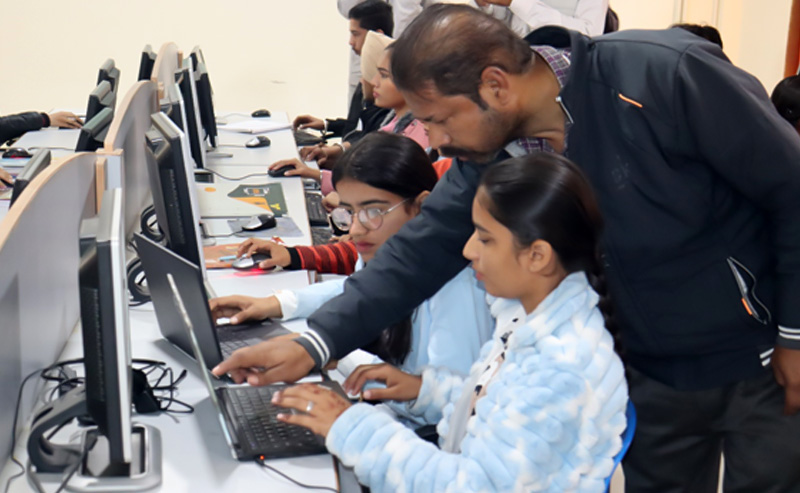
- Computer Labs: Dedicated labs for programming, AI/ML, networking, graphics, and multimedia applications.
Network Infrastructure
- Network Type: Fully structured LAN and Wi-Fi system connecting all academic and administrative buildings.
- Internet Bandwidth: Dual leased lines of 1 Gbps each from reputed ISPs with auto- failover capability.
- Network Devices: 60+ managed switches, 100+ access points, and enterprise-grade routers.
- Firewall Protection: FortiGate enterprise firewall with content filtering and traffic management.
- Wi-Fi Coverage: Available across academic blocks, hostels, library, and open areas.
- Security: VLAN segregation, MAC-based access control, and continuous monitoring by IT Cell.
Server Infrastructure
- Number of Servers: 1
- Configuration: Intel® Xeon® CPU E5-1650 @ 3.20GHz, 32GB RAM, 1TB HDD
- Operating System: Microsoft Windows Server 2012 R2 Datacenter
- Server Room: Centrally air-conditioned, equipped with UPS, CCTV, and restricted biometric access.
- Data Backup: Daily incremental and weekly full backups on secure storage with off- site copies.
- Disaster Recovery: Automated backup and RAID-configured storage system.
IT-enabled Teaching and Learning
- Smart Classrooms: 40+ equipped with interactive panels, digital podiums, and high- lumen projectors.
- Digital Tools Used: MS Teams, Google Meet, Zoom
- Blended Learning: All faculty use LMS platforms for uploading materials, conducting quizzes, and tracking performance.
- e-Content Development: Faculty are trained for video lectures, screencasts, and e- material preparation.
IT Support & Maintenance
- IT Staff: 25 qualified professionals managing installation, troubleshooting, and maintenance.
- AMC: Comprehensive Annual Maintenance Contracts for systems, networking, and software.
- Maintenance: Preventive maintenance schedule every quarter; software patches updated regularly.
Cyber Security & Data Privacy
- Firewall: FortiGate with IPS, web filtering, and malware protection.
- Antivirus: Endpoint protection installed on all systems with centralized monitoring.
- User Policy: Password-protected logins; restricted administrative access.
- Backup Policy: Automated daily backups and encryption for sensitive data.
- Cyber Awareness: Annual awareness workshops and digital safety sessions for staff and students.
Digital Administrative Systems
- ERP Modules: Admissions, Academics, HR, Accounts, Library, and Examination.
- Biometric System: Deployed for faculty and staff attendance.
- Fee Payments: Online portal integrated with secure payment gateway.
- Communication: MS- Teams, Official email and SMS notification system for circulars and notices.
IT Infrastructure in Support Areas
- Library: Equipped with e-journals, e-books, and digital repositories.
- Hostels: 24x7 Wi-Fi access with high-speed connectivity.
- Auditorium: Digitally enabled with projection, sound, and control systems.
- Administrative Offices: Fully computerized with ERP access.
- Faculty Access: Each faculty member is provided with an individual system and high-speed Internet.